
How to Choose an Indianapolis Par-3 Pitch-and-Putt That Actually Improves Your Game
November 2, 2025 · by Admin
Indianapolis has a special kind of golf practice facility that fits real life: a local par-3 golf course built as a pitch-and-putt course. Places like Shortee's Golf let beginners learn without pressure, families play a quick loop after work, and serious golfers sharpen the scoring skills that lower golf scores on any Indianapolis golf course. If you’re comparing options with a driving range, footgolf course, golf lessons, junior golf camps, and short-game/putting help, the best choice isn’t the one with the longest list—it’s the one that supports your short game and schedule.
Use the checklist and scenarios below to choose an Indianapolis par-3 pitch-and-putt you’ll actually use for chipping practice, wedge selection, and putting drills. The right fit makes practice simple, feedback clear, and progress measurable—especially when you can repeat short game tips on the par-3 golf course and then confirm them on the driving range. Above all, it should make you want to come back, because consistency beats intensity in short-game improvement.
A quick self-check: what are you trying to do here?
Before you compare tee mats, greens, or golf rates, decide what “success” looks like for you over the next 30 days at an Indianapolis golf practice facility. A good par-3 pitch-and-putt can support multiple goals, but your priority changes which details matter most—whether that’s golf lessons with qualified golf instructors, a driving range for wedge gapping, or a short-game area for putting drills and chipping practice.
- Learn the basics: grip, setup, contact, and simple rules without feeling rushed.
- Lower your scores: build a reliable wedge and putting routine that travels to any course.
- Practice efficiently: short sessions that still produce clear feedback.
- Plan family time: a mix of golf and footgolf that keeps everyone engaged.
- Develop a junior golfer: camps, coaching, and a safe environment for repetition.
If you can name your top two goals—like “lower golf scores with better wedge selection” and “make putting drills automatic”—the rest of this page becomes a simple decision tree for choosing the right par-3 golf course rather than a guess.
The facility checklist: what to evaluate on your first visit
Walk the property like you’re test-driving it as a golf practice facility. You’re not just buying a bucket on the driving range—you’re choosing a system for short game tips, chipping practice, and putting drills that carry onto a full Indianapolis golf round. The items below are the “tell” that a par-3 pitch-and-putt course is built for learning, not just entertainment.
| What to Check | Why It Matters | A Good Sign |
|---|---|---|
| Par-3 layout variety | Different distances and lies create real decision-making | Mix of short and mid-length holes with multiple shot shapes |
| Greens and fringe condition | Putting and chipping practice should translate to the course | Consistent roll, clear edges, and predictable bounce |
| Short-game area access | You improve fastest when you can repeat one shot type | Space to chip, pitch, and practice bunker or rough shots if available |
| Driving range setup | Range time supports contact, wedges, and warm-ups | Targets at wedge distances and room to swing comfortably |
| Footgolf course flow | Separates activities so everyone enjoys their pace | Clear routing and signage, minimal interference with golfers |
| Staff coaching culture | Small tips can save months of trial and error | Staff offer simple cues and can explain a drill in one minute |
While you’re there, notice how easy it is to start a practice session: parking, check-in, where to warm up on the driving range, and whether the par-3 golf course and short-game area feel welcoming for putting drills. Friction kills habits, and the best Indianapolis pitch-and-putt is the one you’ll use weekly.
Match the venue to your scenario
Two Indianapolis par-3 golf facilities can look similar on paper but feel completely different once you’re actually doing chipping practice, wedge selection work, and putting drills. Use the scenarios below to define what “fit” looks like for you—then compare options based on whether they truly support short game tips, golf lessons, and repeatable practice on the par-3 pitch-and-putt course.
| Your Scenario | Choose a Facility That Prioritizes | Questions to Ask |
|---|---|---|
| New to golf | Low-pressure par-3 play and patient instruction | Do you offer beginner lessons and a simple starter plan? |
| Busy schedule | Fast check-in, flexible range use, quick loops | Can I practice for 30 minutes without feeling rushed? |
| Junior golfer | Structured camps, safety, repeatable fundamentals | How are groups organized by age and experience? |
| Family outing | Footgolf options and a friendly pace for mixed skill levels | What times are best to avoid crowding and waiting? |
| Score-focused adult | Short-game/putting areas and coaching feedback | Do you have drills or lessons focused on wedges and putting? |
If a facility can answer these questions clearly—especially around golf instructors, lesson structure, and how to use the driving range and par-3 course together—it’s a strong sign you’ll make progress and lower golf scores there.
Short-game and putting tips you can test immediately
A par-3 pitch-and-putt course is ideal for turning short game tips into real skill because you can repeat the same chip or putt, see the result, and adjust—then test it again on the next hole. Try these during your next Indianapolis golf practice session, using the short-game area, the par-3 course, and even wedge targets on the driving range—no complicated swing thoughts required.
1) The one-landing-spot chip
For chipping practice, pick a landing spot on the green (or fringe) and commit to it with one club and one simple motion. Your goal is not “hit it close,” but “land it on the spot,” which makes wedge selection and rollout predictable on a par-3 golf course. Once you can do that, proximity improves naturally. Control the landing, and the roll takes care of itself.
2) The 3-foot circle putting test
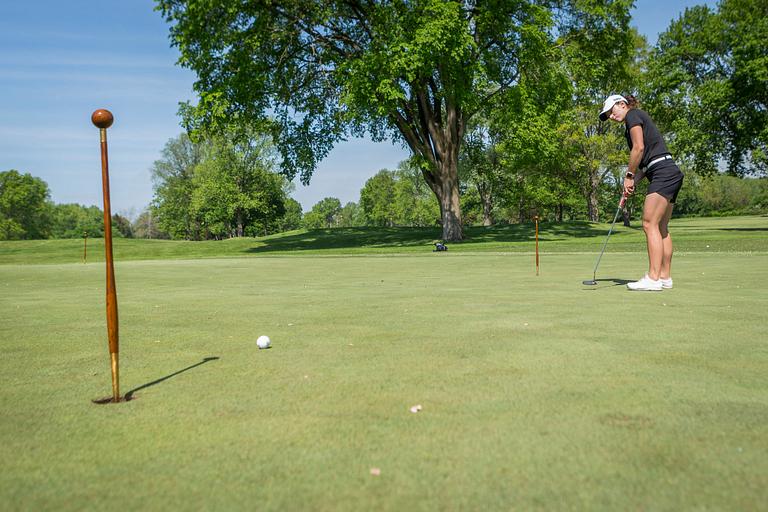
For putting drills, place balls around the hole at roughly three feet from four different angles on the pitch-and-putt greens. Make them all before you move back to build a repeatable stroke that holds up under pressure and helps lower golf scores. If you miss, reset that station and finish it. Short putts are your scoring insurance.

3) The wedge “clock” for distance
On the driving range, pick one wedge and use a consistent “clock” swing length (for example, hands to hip height on the backswing). Hit five balls and note the average carry, then repeat with a slightly longer backswing to dial in wedge selection for par-3 distances. You’re building a personal wedge chart that makes the pitch-and-putt course and any Indianapolis golf round feel simpler.
4) The uphill/downhill reality check
On the par-3 pitch-and-putt course, play two balls when it’s quiet: one conservative line and one aggressive line. Track which choice leaves the easiest next shot—an uphill chip, a straight putt, or a simple two-putt—so your short game tips become real strategy. Over time you’ll learn your “smart miss” on different slopes and pin positions.
Lessons, camps, and range time: a simple plan for the first month
The best way to use an Indianapolis golf practice facility like Shortee's Golf is to pair golf lessons with repeatable practice on the driving range and the par-3 pitch-and-putt course. A lesson without follow-through fades quickly; range balls without coaching can hardwire bad habits. Aim for a rhythm that fits your life and keeps your chipping practice and putting drills consistent.
- Week 1: Take one lesson or short evaluation, then practice the same two drills twice.
- Week 2: Play the par-3 course once, focusing on pre-shot routine and club selection.
- Week 3: Add one range session for wedges and contact, then finish with 10 minutes of putting.
- Week 4: Re-test your 3-foot circle and one-landing-spot chip; note what improved and what didn’t.
For juniors, junior golf camps work best when they’re followed by casual rounds on the par-3 golf course, where kids can apply fundamentals with lots of short shots and quick feedback. For adults, a monthly check-in with golf instructors plus weekly short-game/putting practice—supported by the driving range for wedge selection—often delivers the fastest path to lower golf scores.
When you choose your Indianapolis par-3 pitch-and-putt using this checklist—looking at the driving range, short-game areas, footgolf course flow, golf rates, and access to golf lessons—you’re not just picking a place to play. You’re choosing a routine that makes it easy to show up, easy to practice with purpose, and easy to see progress on the scorecard.